Creating wines, spirits, beers, and ciders that consistently delight consumers is a complex blend of art and science. Producers must carefully balance ingredient ratios, fermentation schedules, aging processes, and flavour profiles. With growing demand for unique expressions and small-batch experimentation, managing recipes and production efficiently has become a competitive necessity.
The Challenge of Recipe Management in Modern Alcohol Production
Traditional recipe management -- paper logs, spreadsheets, or basic software -- is often insufficient for modern producers. Common challenges include:
- Scaling recipes accurately across different batch sizes without compromising quality
- Tracking experimental or limited-edition batches separately from standard production
- Maintaining precise documentation for regulatory compliance and audits
- Coordinating production across multiple facilities or teams
- Integrating lab test results and sensory evaluations into recipe adjustments
How Liquor Logic Supports Recipe Innovation
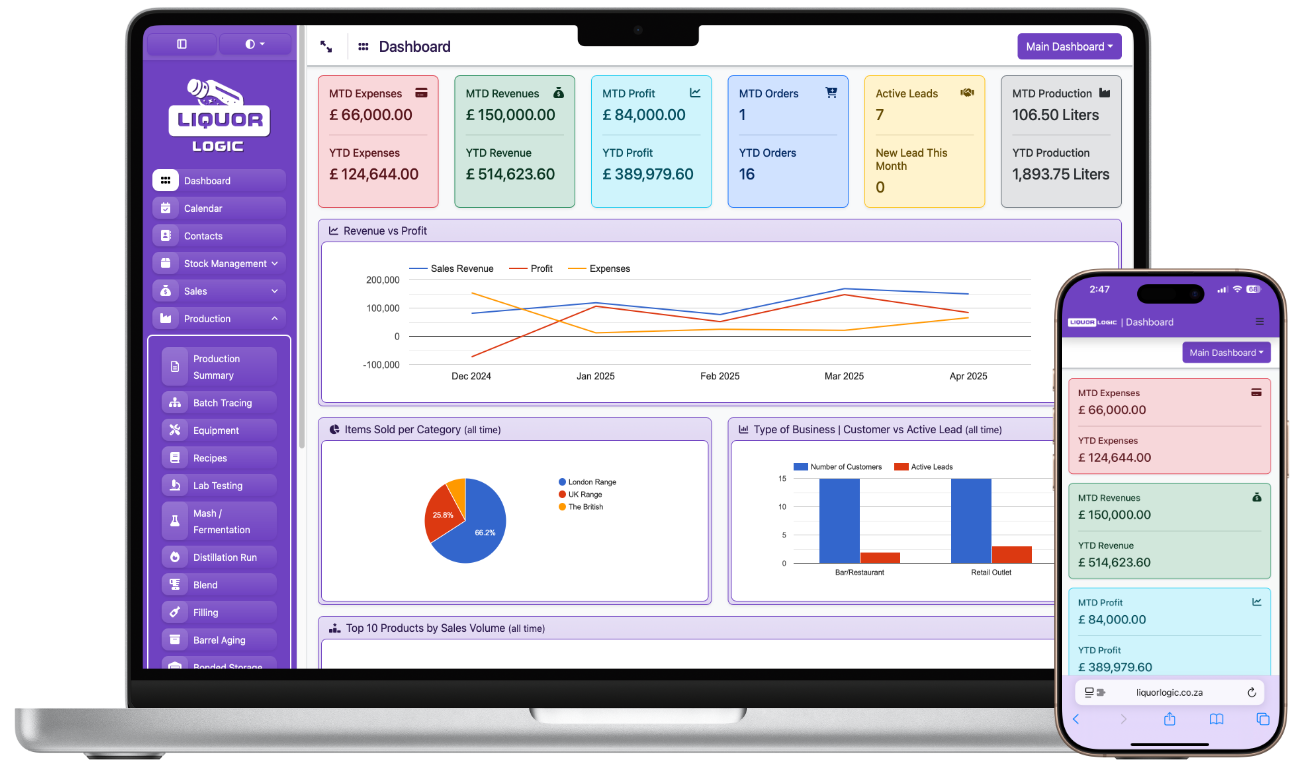
Liquor Logic provides a centralised platform for recipe management, production tracking, and quality assurance. Key features include:
- Recipe storage and versioning: Keep multiple variations of a recipe -- including experimental or seasonal versions -- with full version control and change history.
- Automated ingredient scaling: Calculate required quantities for raw materials based on batch size, yield, and production method.
- Lab integration: Input lab test results for sugar content, alcohol percentage, and other critical quality parameters directly into production records.
- Experimental batch tracking: Test new flavour combinations or processes without affecting main production data.
- Cross-team collaboration: Production, lab, and management teams can access and update recipe details in real time.
Optimising Production Through Data-Driven Insights
Technology enables producers to make data-driven decisions that improve both efficiency and product quality:
- Monitor fermentation rates, distillation outputs, and aging progress across multiple batches simultaneously
- Analyse historical recipe performance to fine-tune ingredient ratios and processes
- Detect inconsistencies early, reducing the risk of off-flavours or defective batches reaching packaging
- Streamline workflow by integrating recipe planning, lab results, and production logs in a single system
Case Study: Distillery Innovating With Botanical Infusions
A boutique distillery wanted to experiment with botanical infusions while maintaining consistent quality across their core range. Using Liquor Logic, the team was able to:
- Create multiple experimental batch records without disrupting core production data
- Track ingredient yields, infusion times, and alcohol content accurately across each trial
- Compare lab test results against target flavour profiles to guide reformulation decisions
- Determine quickly whether a batch was suitable for commercial release or needed adjustment
The result was a faster path from concept to shelf, with a clear audit trail for every decision made along the way.
Recipe Innovation Questions Producers Ask Most
How do you protect a proprietary recipe while still using shared production software?
Role-based access control is the answer. In Liquor Logic, recipe details can be restricted to specific users -- meaning your head distiller or head brewer can access and modify formulations, while production floor staff only see the quantities and instructions relevant to their role. Full recipe composition, ingredient sources, and formulation rationale remain visible only to those with appropriate permissions.
What is the best way to document recipe changes for compliance purposes?
Every recipe change should be logged with a date, the name of the person making the change, the specific modification made, and the reason for the change. Version control in your recipe management software creates this audit trail automatically. For spirits with defined legal classifications -- bourbon, Scotch, South African brandy -- any recipe change that affects the classification criteria must be carefully reviewed against the relevant standard before production proceeds.
How does recipe management software handle co-products and by-products?
In distillation particularly, the same production run often yields multiple outputs -- heads, hearts, and tails from a pot still run, for example. Purpose-built distillery software tracks each cut as a separate inventory item with its own volume, ABV, and cost allocation. This allows accurate costing of the final product (hearts), correct excise calculation for each output, and proper inventory management of by-products that may be redistilled or disposed of.
Conclusion
In today competitive alcohol market, recipe innovation is a key differentiator. By leveraging technology like Liquor Logic, wineries, distilleries, breweries, and cideries can streamline recipe management, ensure consistency, and experiment with new expressions confidently. The result is not just better products -- it is a more efficient, compliant, and scalable operation built on data rather than guesswork.