Microbrewery inventory management: the complete guide for South African craft brewers
Running a microbrewery in South Africa means juggling hops, malt, yeast, packaging materials, finished stock — and SARS compliance — all at once. For many small craft brewers, inventory management is the thing that keeps them up at night. In this guide, we break down exactly what good microbrewery inventory management looks like, what it costs you when you get it wrong, and how purpose-built software changes the game.
Why inventory management is different for microbreweries
A microbrewery is not a retailer. You're not simply counting units in and units out. You're transforming raw ingredients into a finished product through a multi-stage production process — and every stage affects your stock levels, your costs, and your compliance obligations.
This means you need to track inventory at multiple levels simultaneously:
- Raw materials — hops, malt, adjuncts, yeast, water treatment chemicals
- Work-in-progress — fermenting batches, conditioning tanks, dry-hopping additions
- Finished goods — kegs, cans, bottles, and growlers by SKU
- Packaging materials — labels, caps, cartons, and kegs themselves
Traditional inventory software built for retail or warehousing simply doesn't account for this kind of production complexity. That's why so many South African craft brewers end up on spreadsheets — and why those spreadsheets eventually break down.
The real cost of poor inventory management at a microbrewery
Poor inventory practices don't just cause admin headaches. They hit your bottom line in ways that aren't always immediately obvious:
- Over-ordering raw materials that expire before use, increasing waste costs
- Running out of a key ingredient mid-batch, causing production delays and lost revenue
- Inaccurate yield tracking that makes it impossible to cost your products correctly
- Compliance failures — SARS requires accurate records of production volumes, and gaps in your records can trigger audits and penalties
- Inability to scale — without reliable data, you can't confidently plan growth or secure financing
What good microbrewery inventory management looks like
Effective inventory management at a microbrewery covers three core areas:
1. Ingredient tracking from purchase to brew
Every ingredient you receive should be logged with its quantity, cost, supplier, and batch details. As you brew, the system should automatically deduct ingredients based on your recipe, giving you a real-time picture of what's on hand at all times. This removes the guesswork and prevents costly surprises mid-production.
2. Batch-level production tracking
Each brew batch needs to be tracked from start to finish — including actual yields versus expected yields, losses at each stage (mash, boil, fermentation, packaging), and the total cost of that batch. This data is what lets you accurately price your products and identify inefficiencies in your process.
3. Finished goods and distribution management
Once your beer is packaged, you need to know exactly what's in stock, what's been dispatched, to whom, and at what price. This is especially important for South African producers who sell across multiple channels — taproom, wholesale, and direct delivery — each with different pricing and compliance requirements.
Excise compliance: the inventory management obligation you can't ignore
In South Africa, SARS requires all alcohol producers to maintain accurate records of production volumes and report excise duty accordingly. Poor inventory management directly undermines your ability to meet these obligations.
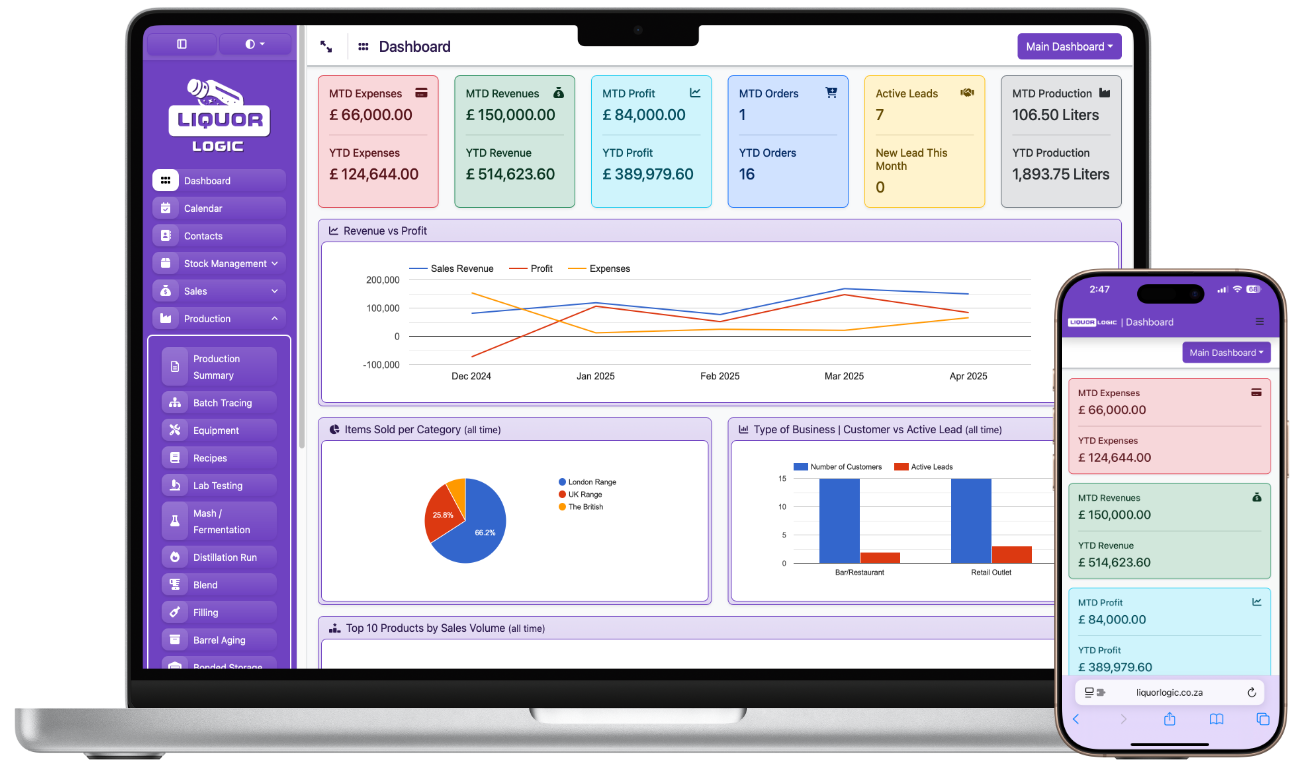
A purpose-built brewery management system like Liquor Logic handles excise reporting automatically, pulling production data directly from your batch records so you're always audit-ready — without the manual effort.
Why spreadsheets stop working as you grow
Many microbreweries start on spreadsheets, and for a tiny operation brewing one or two batches a month, it can work. But as volume increases, the cracks start to show:
- Multiple people editing the same file leads to version conflicts and errors
- Manual data entry is time-consuming and prone to mistakes
- There's no automatic link between your recipe, your production, and your stock levels
- Generating compliance reports requires hours of manual reconciliation
- You have no real-time visibility — your data is always a day or a week behind
At some point, every growing brewery hits a wall where the spreadsheet costs more time and money than a proper system would.
How Liquor Logic simplifies microbrewery inventory management
Liquor Logic is designed specifically for South African alcohol producers — including microbreweries, craft beer producers, and small-scale distillers. The platform connects every part of your operation in one place:
- Raw material tracking — log deliveries, track stock levels, and get low-stock alerts automatically
- Recipe-based batch management — link your recipes to production so ingredient deductions happen automatically
- Real-time costing — know the cost of every batch as it's being produced, not weeks later
- Finished goods inventory — track stock across taproom, warehouse, and dispatch in real time
- Automated excise reporting — generate SARS-compliant excise reports directly from your production data
Getting started with better inventory management
You don't need to overhaul everything overnight. The best approach for most South African microbreweries is to start with the fundamentals — raw material tracking and batch production logging — and build from there. Once those are in place, the rest of the picture (costing, compliance, finished goods) falls into line naturally.
If you're ready to move beyond spreadsheets and get real control over your microbrewery's inventory, Liquor Logic is built for exactly that. Purpose-built for South African producers, compliant with local regulations, and designed to grow with your business.