What is excise duty? A plain-English guide for South African alcohol producers
Excise duty is one of the most misunderstood obligations facing South African alcohol producers — and getting it wrong can be costly. Whether you're a craft brewer, winemaker, or distiller, this guide explains what excise duty is, how it's calculated in South Africa, and what you need to do to stay compliant with SARS.
What is excise duty?
Excise duty is a tax levied by the South African government on the production and sale of certain goods — including alcoholic beverages, tobacco, and fuel. Unlike VAT, which is charged at the point of sale to the end consumer, excise duty is charged at the point of production or import.
For alcohol producers, this means you are liable for excise duty based on the volumes of alcohol you produce, not what you sell. SARS administers excise duty in South Africa under the Customs and Excise Act.
Who is liable for excise duty on alcohol in South Africa?
If you manufacture any of the following in South Africa, you are required to be registered as an excise manufacturer with SARS and to pay excise duty on your production:
- Beer and malt beverages
- Wine, sparkling wine, and fortified wine
- Spirits and distilled beverages (whisky, gin, vodka, brandy, etc.)
- Cider and other fermented fruit beverages
- Traditional African beer (umqombothi and similar)
This applies regardless of the size of your operation — whether you're a large commercial producer or a small craft brewery. If you're producing alcohol for sale, excise duty applies.
How much is excise duty on alcohol in South Africa?
Excise duty rates in South Africa are set annually in the national budget by the Minister of Finance. The rates differ depending on the type of beverage and are typically expressed per litre of absolute alcohol (LAA) or per litre of product.
As a general guide, the duty is structured as follows:
- Beer — duty is levied per litre of beer based on its alcohol content
- Wine — duty is levied per litre of wine, with different rates for unfortified, fortified, and sparkling wine
- Spirits — duty is levied per litre of absolute alcohol, making the alcohol percentage a critical factor
- Cider and alcoholic fruit beverages — typically taxed at a similar rate to beer
Because rates change annually and vary significantly by product type, it's important to work with current SARS tariff schedules or use software that keeps these rates updated automatically.
How is excise duty calculated for alcohol producers?
The calculation of excise duty depends on your product type, but in every case it starts with accurate production volume data. Here's a simplified example for a craft brewery:
- Determine the total volume of beer produced in the excise period
- Determine the average alcohol by volume (ABV) of that production
- Calculate the litres of absolute alcohol (LAA) — volume × ABV percentage
- Apply the relevant SARS excise rate per litre of product or LAA
- Submit your excise account and pay the amount due to SARS
This sounds straightforward, but in practice it requires meticulous batch-level records. If your production data is inaccurate or incomplete, your excise calculation will be wrong — and that creates compliance risk.
What are the excise duty obligations for South African producers?
Registered excise manufacturers in South Africa must:
- Maintain a licensed excise warehouse — all dutiable goods must be stored in a licensed facility
- Keep accurate production records — including volumes produced, stock on hand, and volumes removed from the warehouse
- Submit excise accounts monthly — reporting production and removals to SARS on the prescribed schedule
- Pay duty on time — late payment attracts interest and penalties
- Be available for SARS inspection — your records and premises can be audited at any time
Non-compliance with excise requirements is taken seriously by SARS and can result in significant financial penalties, suspension of your licence, or in serious cases, criminal prosecution.
Common mistakes South African alcohol producers make with excise duty
Even well-intentioned producers fall into common traps when it comes to excise compliance:
- Incomplete production records — if your batch records don't capture volumes accurately at each stage, your excise calculation will be off
- Not accounting for losses — fermentation losses, evaporation, and spillage need to be properly documented, or you may over-report production volumes
- Using incorrect ABV figures — small differences in measured ABV compound into significant duty discrepancies at scale
- Missing deadlines — excise accounts must be submitted and paid by specific dates; missing these triggers penalties automatically
- Mixing up dutiable and non-dutiable removals — exports and certain transfers are handled differently; misclassification causes errors
How software makes excise compliance easier
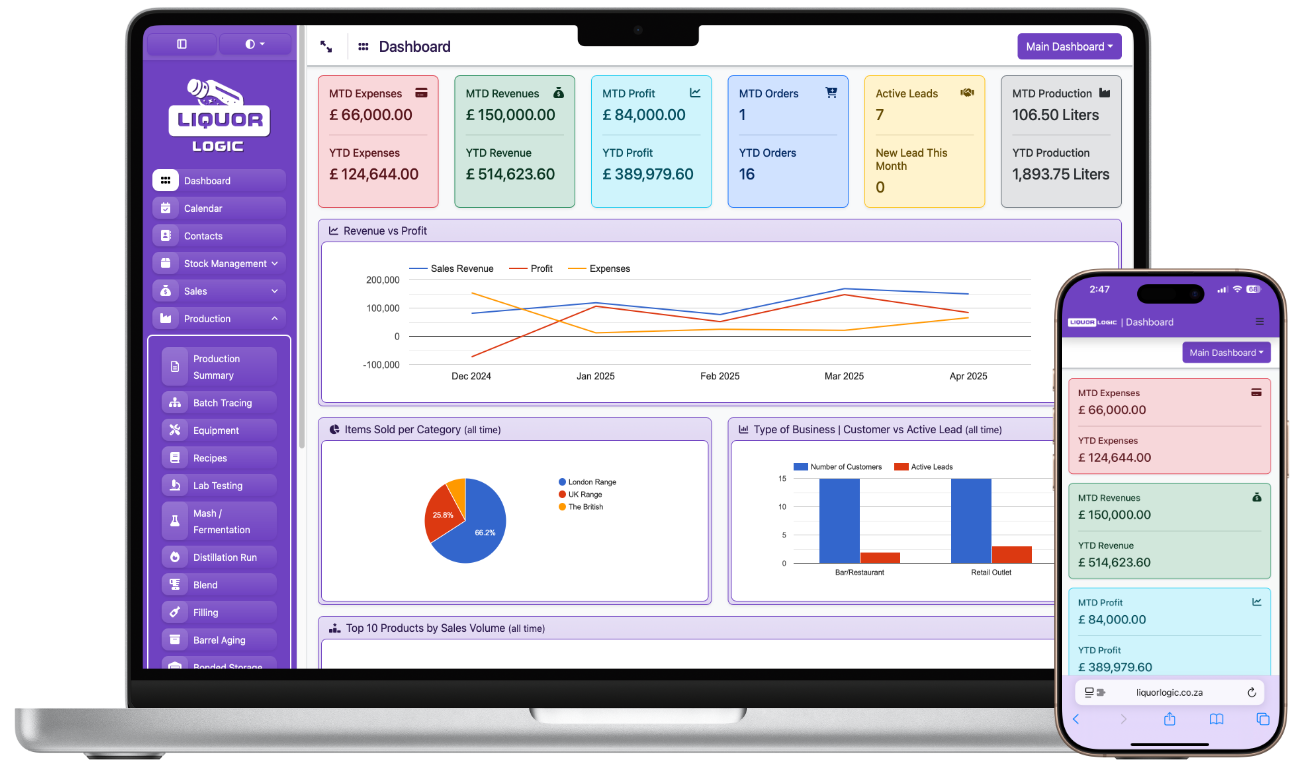
Managing excise duty manually — through spreadsheets or paper records — is not only time-consuming, it's inherently risky. A purpose-built solution like Liquor Logic integrates excise compliance directly into your production process:
- Automated excise calculations — duty is calculated in real time based on actual production data, using current SARS rates
- Accurate batch records — every production run, yield, and loss is logged automatically, giving you an auditable trail
- Excise account reporting — generate your monthly SARS submissions directly from your production records with minimal manual effort
- Inventory integration — stock movements in and out of your excise warehouse are tracked automatically, keeping your records compliant at all times
Stay on the right side of SARS
Excise duty is a non-negotiable part of operating as an alcohol producer in South Africa. The good news is that with the right systems in place, compliance doesn't have to be a burden. Accurate production records, current duty rates, and automated reporting make the whole process manageable — and give you peace of mind when SARS comes knocking.
Liquor Logic is purpose-built for South African alcohol producers who want to stay compliant without drowning in admin. From batch tracking to excise reporting, everything is connected in one place.